

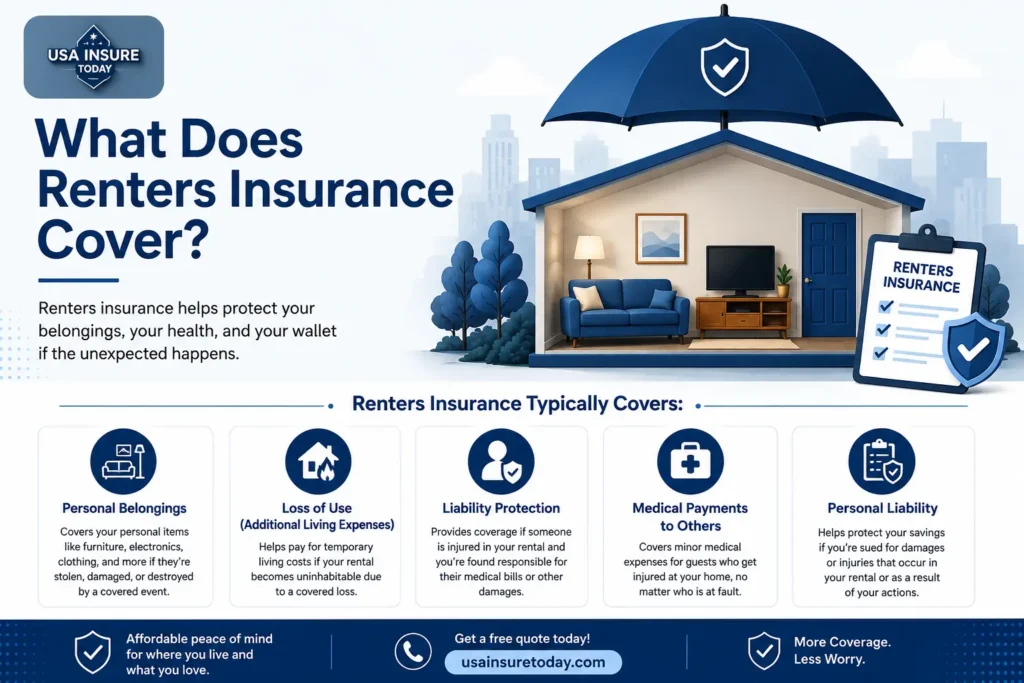
Renters insurance in the USA protects your belongings, your liability, and your temporary living costs when something goes wrong in your rented home. This complete 2026 guide from USA Insure Today explains what renters insurance covers, what it does not cover, how much it costs, and how much coverage you really need as a U.S. renter.
We also explain the core SEO concept of keywords near the end, so you understand how this information is structured for you and for search engines.
1. What Is Renters Insurance? (Quick Answer)
Renters insurance is a simple policy made for people who rent a home, apartment, condo, or room. It does not insure the building itself. That part is the landlord’s job. It insures you and your everyday life.
Renters insurance usually covers three big areas:
- Your personal belongings (your stuff)
- Your liability if you hurt someone or damage their property
- Your extra living costs if your rental becomes unlivable after a covered event
So when you ask, what does renters insurance cover, you are really asking how it protects your stuff, your responsibility, and your lifestyle.
Who Is Renters Insurance For?
In the USA, renters insurance is for almost anyone who rents:
- People in apartments, condos, or townhomes
- Families renting houses in suburbs or cities
- Students living off‑campus in rented housing
- Roommates sharing a rented unit
If you pay rent every month, renters insurance is built for you.
Who Should Have It in the USA?
You should strongly consider renters insurance if:
- You own electronics, furniture, jewelry, or branded clothing
- You cannot easily replace all your belongings out of pocket
- You have guests visiting your home and want protection if they are injured
- Your landlord requires renters insurance in your lease (many do now)
For most U.S. renters, renters insurance is one of the cheapest ways to buy serious protection.
2. What Does Renters Insurance Cover? (Full Breakdown)
Most U.S. renters insurance policies (often called HO‑4 policies) cover certain events, known as covered perils. When these events happen, your policy helps pay for the loss, up to your limits and minus your deductible.
Common Covered Events
Here are typical events included in renters insurance coverage:
- Theft
If someone breaks into your apartment and steals your laptop, TV, or jewelry, renters insurance usually covers the loss up to your policy limit. - Fire
Fire can destroy furniture, clothes, and electronics. Renters insurance helps you replace damaged items and may also cover smoke damage. - Smoke damage
Even a small fire can produce smoke that ruins your belongings. Smoke damage is normally a covered event. - Certain water damage
If a pipe bursts, a washing machine hose breaks, or an air conditioner leaks suddenly and damages your belongings, renters insurance can help. Slow leaks and floods are treated differently. - Vandalism
If someone breaks in and destroys your things or spray‑paints your walls, your personal property loss can be covered. - Windstorm and hail
Strong winds or hail can break windows or damage items in your home. These events are usually covered perils.
Main Coverage Areas
Typically, what is covered by renters insurance falls into these three categories:
- Personal belongings
Your furniture, electronics, clothes, kitchen items, décor, and more. - Temporary living expenses
Hotel, food, and temporary rent if your home becomes unlivable after a covered event. - Personal liability and medical payments
Your legal responsibility if someone is injured or if you damage someone’s property, plus small medical payments to others.
In short, renters insurance coverage aims to keep you financially stable when bad things happen to your rented home.
3. What Does Renters Insurance NOT Cover?
It is very important to understand what renters insurance does not cover. Many renters only think about “coverage” and ignore exclusions.
Standard renters insurance policies generally do not cover the following:
- Flood
Damage from rising water, heavy rain that leads to flooding, or storm surge is usually not covered. For that, you need separate flood insurance. - Earthquake
Earthquake damage is also excluded in most standard renters policies. Some insurers sell special earthquake coverage. - Pest damage
Damage from bed bugs, termites, rodents, or cockroaches is normally excluded. These are treated as maintenance problems. - Wear and tear
Normal aging, wear, and gradual damage to your items are not covered. Insurance is for sudden, accidental events, not routine deterioration. - Intentional damage
If you intentionally destroy your own property or someone else’s property, the insurer will not pay. - Car theft
Your car itself is not covered under renters insurance. Car theft is handled by auto insurance. Personal property inside the car may be covered, depending on your policy.
When you think about renters insurance coverage, remember that you must look at both what is included and what is excluded to know the full picture.
4. Personal Property Coverage (Your Stuff)
Personal property coverage is the heart of renters insurance. It protects the value of your belongings when a covered event occurs.
Here are clear examples of what personal property coverage can include:
- Laptop
If your laptop is stolen from your apartment or destroyed in a fire, renters insurance can help pay to replace it, up to your limit and minus your deductible. - TV
If your TV is damaged by smoke, fire, or vandalism, it is usually covered. - Furniture
Sofas, beds, tables, chairs, and shelves damaged by fire, smoke, or certain water events can be covered. - Clothes
Clothing stolen in a burglary or ruined in a fire is often covered as part of personal property. - Jewelry
Jewelry is generally covered, but usually with special lower limits (for example, 1,500–2,500 USD). High‑value pieces may need extra scheduled coverage. - Electronics
Phones, tablets, gaming consoles, cameras, and speakers are typically covered, again subject to policy limits.
Does Renters Insurance Cover Theft?
Yes, renters insurance usually covers theft of personal property, both inside and sometimes outside your home.
But remember:
- You must pay your deductible before the insurer pays the rest.
- The insurer pays up to your personal property limit.
- Some policies have lower limits for items stolen outside the home or from storage units.
This is why “does renters insurance cover theft” is both a common search question and a vital part of understanding your renters insurance coverage.
5. Liability Coverage (When You Are Responsible)
Liability coverage protects you if you are legally responsible for someone’s injury or property damage. It can cover legal defense costs and settlements or judgments, up to your policy limit.
Real‑Life Liability Examples
- Dog bite
Your dog bites a guest in your apartment. They need medical care and may sue you. Liability coverage can help pay medical costs and legal damages, depending on the policy and the dog breed rules. - Guest slips and falls
A friend slips on a wet floor in your kitchen and breaks an arm. Liability coverage can help pay their medical bills and cover your legal risk. - Child breaks neighbor’s window
Your child throws a ball and breaks the neighbor’s window. Liability coverage can help pay for repair or replacement.
Typical liability limits range from 100,000 to 300,000 USD, and you can buy higher limits for more protection.
6. Additional Living Expenses (ALE)
Additional Living Expenses, often called Loss of Use, help you pay for extra living costs if your rental becomes uninhabitable after a covered event.
Examples of ALE
- Hotel stays
After a fire, you might need to stay in a hotel while your apartment is repaired. ALE can help pay for the hotel cost. - Restaurant meals
If you cannot cook because you are in a hotel or temporary place without a kitchen, ALE can help with extra food expenses. - Temporary apartment
For longer repairs, ALE can help pay rent on a short‑term apartment or extended‑stay rental until you can move back home.
ALE aims to keep your lifestyle roughly similar to before the loss, not to upgrade you to luxury vacations or premium resorts.
7. Actual Cash Value vs Replacement Cost
An important part of what renters insurance covers is how it pays you after a loss. Two common payout methods are:
- Actual Cash Value (ACV)
- Replacement Cost (RC)
These options affect how much money you receive for a claim.
Key Differences in a Simple Table
| Feature | Actual Cash Value (ACV) | Replacement Cost (RC) |
| How value is calculated | Original price minus depreciation | Price of a new similar item today |
| Payment for a 5‑year‑old TV | The TV’s current used value | Cost of a new TV with similar features |
| Premium cost | Usually cheaper | Usually more expensive |
| Result after big loss | You get less money because items are “old” | You can more easily replace items with new ones |
| Best for | Tight budgets, basic protection | People with higher‑value belongings |
Simple Example
You bought a laptop for 1,000 USD four years ago:
- With ACV, the insurer may pay only 300–400 USD because the laptop has lost value over time.
- With RC, the insurer pays what it costs today to buy a similar new laptop, maybe 800–1,000 USD.
So when you study renters insurance coverage, look at the payout method, not just the list of covered items.
8. Average Cost of Renters Insurance in the USA (2026)
In 2026, renters insurance in the USA typically costs around 120–280 USD per year, which is about 10–20 USD per month for standard coverage.
State‑Level Cost Examples (Approximate)
These ranges are rough examples and vary by insurer and ZIP code:
- Texas – higher storm risk, often around 15–20 USD/month
- California – wildfire risk, often around 14–18 USD/month
- New York – city apartments, often around 12–18 USD/month
- Florida – hurricane risk, often around 16–22 USD/month
- Midwestern states (such as Ohio or Iowa) – often around 10–15 USD/month
Your exact cost depends on your address, building type, and coverage choices.
Factors That Affect Price
Several factors change the price of your renters insurance:
- Location (state, city, crime rate, weather risks)
- Coverage limits (how much protection for property and liability you choose)
- Deductible (higher deductibles usually mean lower monthly premiums)
- Building age and security (newer, more secure buildings may be cheaper)
- Claim history (more past claims can raise your price)
- Add‑ons (extra coverage for jewelry, collectibles, earthquake, or identity theft)
9. How Much Renters Insurance Coverage Do You Need?
Choosing how much renters insurance coverage you need means matching the policy to your lifestyle and belongings.
Small Apartment (Studio or One‑Bedroom)
- Contents: 15,000–25,000 USD can be enough for basic furniture and electronics.acornquotes
- Liability: at least 100,000 USD is wise, even for a small space.
Family in a Larger Rental
- Contents: 30,000–50,000 USD or more to cover multiple bedrooms, kids’ belongings, and family electronics.
- Liability: often 300,000 USD or more for stronger protection.
Students
- Contents: 10,000–20,000 USD may be enough for a student with a laptop, phone, clothes, and a few furniture pieces.
- Liability: at least 100,000 USD, since accidents in shared housing and parties are common.
Luxury Apartment
- Contents: 50,000–100,000+ USD if you own high‑end furniture, designer clothing, expensive electronics, artwork, or collectibles.
- Extra coverage: separate riders or scheduled coverage for luxury jewelry or watches.
A simple method is:
- Make a list of your major items.
- Estimate their total value.
- Choose a coverage limit slightly above that number.
This way, your renters insurance coverage better matches your real life.
10. Common Renters Insurance Claims
Certain types of claims are especially common for U.S. renters:
- Fire claims
Kitchen fires, electrical fires, and candle fires are frequent sources of damage. - Theft claims
Burglaries, stolen bikes, stolen electronics, and stolen jewelry are major reasons for claims. - Water damage claims
Burst pipes, broken hoses, and sudden leaks that damage floors and belongings are typical. - Storm claims
Wind or hail breaking windows or damaging items inside the home leads to many claims.
These events show why renters insurance is a smart protection for everyday renters in the USA.
11. FAQs (Short, One‑Line Answers)
All answers here are kept to one line, following the rule that longer answers belong in dedicated sections.
1. Is renters insurance required?
It is not required by law, but many landlords in the USA make it a lease requirement.
2. What does renters insurance cover?
It covers your belongings, your liability, and your extra living expenses after covered events.
3. Does renters insurance cover theft?
Yes, standard renters policies usually cover theft of personal property within policy limits.
4. Does renters insurance cover water damage?
Sudden, accidental water damage is usually covered; flood damage is generally not.
5. Does renters insurance cover mold?
Slow mold growth is often excluded; mold from a sudden covered leak may have limited coverage.
6. Does renters insurance cover pets?
Your pet itself is not covered, but liability may cover injuries your pet causes to other people.
7. Is renters insurance worth it?
Yes, because low monthly premiums protect thousands of dollars in property and liability risk.
8. Can roommates share renters insurance?
Sometimes, if all roommates are named on the policy; it does not automatically cover everyone.
9. Does renters insurance cover moving?
Some policies cover theft or damage during moving, but you must check your specific policy terms.
10. Does renters insurance cover bicycles?
Yes, bikes are usually treated as personal property and covered for theft and certain damages.
11. Does renters insurance cover jewelry?
Yes, but with low limits, so high‑value items may need extra scheduled coverage.
12. Final Summary and Brand Mention
Renters insurance is a low‑cost way to protect your belongings, your liability, and your lifestyle as a renter in the USA. It covers common risks like theft, fire, smoke, certain water damage, vandalism, windstorms, liability, and temporary living costs, while excluding events like flood, earthquake, pest damage, and normal wear and tear.
